Bypass vs Telescopic Sliding Doors
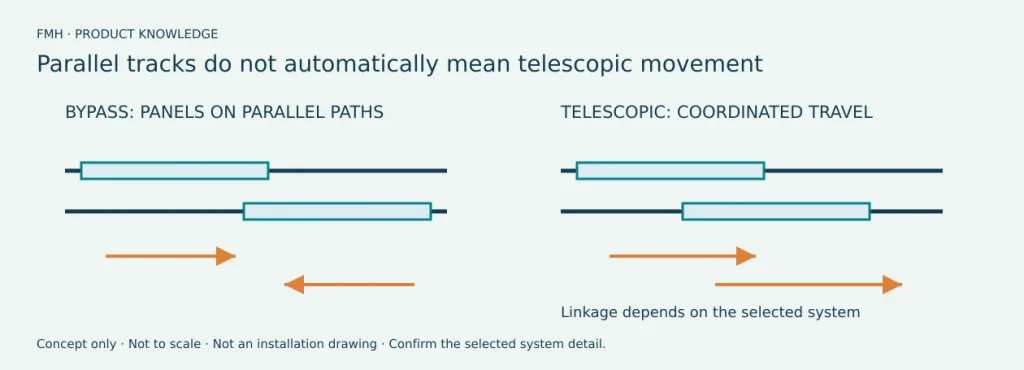
Bypass doors move on parallel paths so one panel can pass in front of another. A telescopic arrangement uses a coordinated movement in which panels gather or extend in a defined sequence. Both can serve wide openings, but they should not be drawn or specified as the same mechanism.
Start with the desired fully open condition and work backwards to the panel and track arrangement.
Bypass panels share overlapping access
In a typical bypass layout, panels remain on their separate tracks and overlap as they move. The opening available at one time depends on the number of panels, their widths and their parking positions.
This can suit an opening where access is needed to different sections at different times. It does not automatically provide the whole wall opening as an unobstructed passage.
Telescopic movement coordinates the panels
A telescopic system can use a linkage, cable, belt or other manufacturer-designed arrangement to coordinate movement. The selected design establishes the relationship between the panels and their travel.
A set of independent parallel tracks does not become a telescopic system merely because the panels can be pushed together manually.
Allow for track depth and overlap
Multiple panel paths require space across the depth of the opening or pocket. Include the panel thicknesses, separation, fittings and required clearances.
Panel overlap affects coverage when closed and the stack when open. Use the exact system drawing rather than dividing the opening width by the number of leaves without further allowances.
Coordinate handles, stops and guidance
Handles must clear neighbouring panels. Stops need to produce the correct resting positions, while guides must control each panel throughout the intended movement.
Damping and locking also require configuration-specific review. A soft-close device intended for a single panel should not be assumed to control a linked group without approval.
| Check | Bypass arrangement | Telescopic arrangement |
|---|---|---|
| Movement | Panels pass on parallel paths | Panels move in a coordinated sequence |
| Key layout issue | Overlap and accessible portion | Travel relationship and parking stack |
| Hardware review | Track and guide for each path | Complete linkage and compatible components |
For a multi-panel enquiry to FMH, provide the intended open and closed layouts. A multi-leaf application label, including one on a PE13 page, does not by itself confirm telescopic or synchronised operation.
Common questions
Do all bypass doors open together?
No. Independent movement is common; linked movement requires a compatible mechanism.
Does a telescopic system eliminate the parking area?
No. The gathered panels and hardware still occupy space.