Concealed vs Exposed Sliding Door Tracks
An exposed sliding track makes its operating hardware part of the visible design. A concealed arrangement hides some or all of that hardware behind a cover, within a recess or through a specialised panel system.
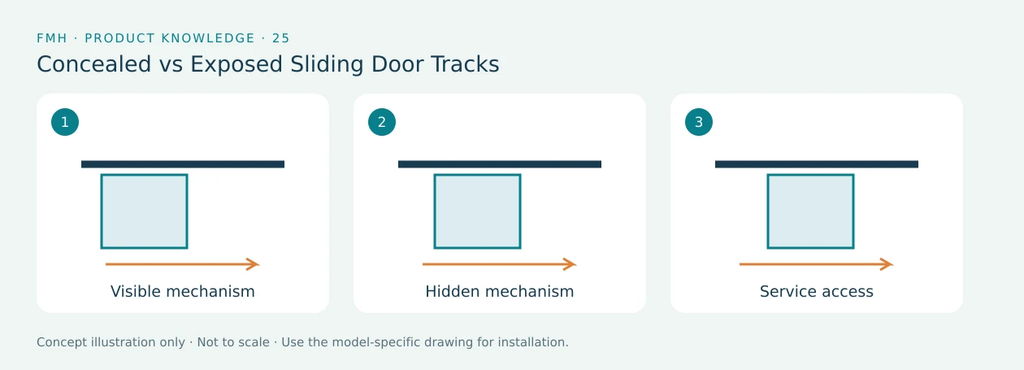
Concealment changes the visual result, but it does not remove the need for structural support, guidance or service access.
Identify what is actually hidden
A covered overhead rail, a ceiling-recessed track and a ghost-door mechanism are different arrangements. They can all be described as concealed in casual conversation, yet require different panel preparation and building details.
Ask for a section and a photograph from the relevant viewing angles. A fascia that hides the rail from the front may leave it visible from the side or below.
Compare the installation envelope
An exposed system may make the running components easier to locate visually, but still needs the correct brackets and clearances. A recessed system may need additional coordination at the ceiling or head of the opening.
Allow space for installing the panel, connecting the hangers and reaching the adjustments. The smallest visible gap is not necessarily the smallest construction requirement.
Check how the hardware is serviced
Ask which cover or trim is removed and whether the panel must come down first. A removable component should have a realistic removal route after all finishes are installed.
An exposed track is not automatically maintenance-free, and a concealed one is not automatically inaccessible. The service method belongs to the actual system and finishing detail.
Keep performance claims separate from appearance
A hidden track is not proof of higher load capacity, quieter operation or better acoustic separation. Those characteristics need their own product information and, where relevant, evidence for the complete assembly.
The same applies to a large visible wheel. Appearance alone does not establish durability or suitability for a heavy panel.
Choose using the project’s priorities
| Priority | Question to resolve |
|---|---|
| Visual simplicity | Which components remain visible from each side? |
| Limited head space | What construction and assembly space is required? |
| Future maintenance | How are running parts reached and replaced? |
| Existing panel | Is new preparation required? |
The FMH PE13 page describes a concealed ceiling-track concept. Confirm the exact model application and current drawings before using it in a finished detail.
Common questions
Is concealed hardware always more difficult to install?
Not necessarily. Some systems simplify assembly, but their building interfaces still require coordination.
Can I hide an ordinary rail behind any cover?
Only if the cover preserves the required clearances, adjustment access and service route.