Pocket Doors vs Wall-Mounted Sliding Doors vs Folding Doors
The practical difference between these door types is where the panel goes when the opening is in use. Pocket doors enter a wall cavity, wall-mounted sliding doors travel beside the wall, and folding doors gather into a stack. Each arrangement exchanges one kind of space for another.
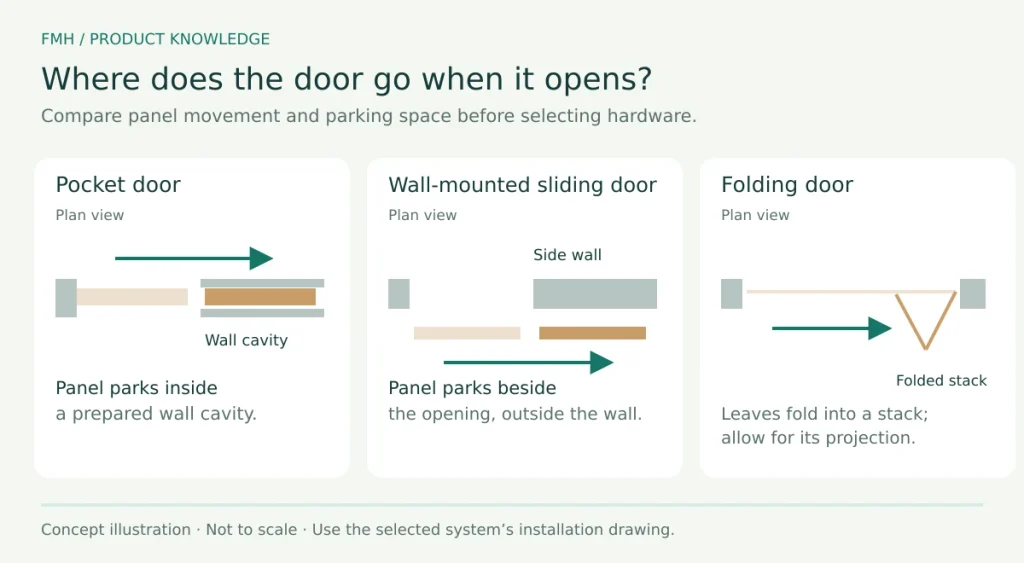
Choose the movement before choosing the visual finish. A door that looks compact in a photograph can still conflict with furniture, services or circulation in the actual room.
Pocket doors use space inside the wall
A pocket system removes the open panel from the room, but the wall needs an unobstructed receiving cavity. Its framing, finishes, services and fixings must be coordinated with that cavity. An existing solid wall is not automatically ready to accept a pocket frame.
Allow for panel retrieval and servicing. A recessed panel may require an edge pull or a compatible release device, and the opening detail must allow access to the running hardware. These are part of the initial design, not finishing choices to leave until the wall is closed.
Wall-mounted doors use space beside the opening
A surface-sliding arrangement can be easier to coordinate when a usable side wall already exists. The panel still needs a clear travel path. Check switches, skirting, handles, wall-mounted furniture and any trim projecting into that path.
The track may be visible or concealed, but hiding it does not remove the parking requirement. Some concealed arrangements also impose specific panel preparation and floor conditions.
Folding doors create a stack
Folding leaves reduce the length of individual panels moving through the room, but the open stack occupies space. Its position depends on the selected folding arrangement. End-folding and centre-folding systems should not be drawn as if they park identically.
Check the clear passage after allowing for the stack, as well as the swept area while the leaves move. A folding system may use top support, bottom support or another specified arrangement; choose the mounting detail with the hardware.
| Question | Wall-mounted sliding | Folding | |
|---|---|---|---|
| Where does the panel park? | Inside a receiving cavity | Beside the wall | In a folded stack |
| Main space to reserve | Wall cavity and its construction | Side-wall travel zone | Stack and folding movement |
| Early coordination issue | Services and pocket framing | Wall projections and support | Leaf layout and clear opening |
| Service planning | Hardware access through the opening detail | Track and hanger access | Hangers, hinges and guides |
Compare the opening that people can actually use
Draw each option in its fully open position. Measure the unobstructed passage rather than comparing nominal door widths. A handle that prevents full retraction, a stop set short of its intended position or a folded stack can change the result.
Also consider furniture during movement. The final parked position may be clear even when the moving panel passes through an occupied area.
Make the choice with a simple plan
Show the opening, adjacent walls, furniture and the panel path on one drawing. Add a section for any concealed hardware. This reveals the building work and space requirement more reliably than a style label.
If a pocket arrangement suits the project, review FMH PD12 wooden pocket-door hardware alongside the proposed wall construction. Hardware and pocket framing still need to be coordinated as one installation.
Common questions
Does a pocket door always provide the widest passage?
No. Retrieval hardware, stops and the selected frame detail affect how far the panel retracts.
Is a concealed sliding door necessarily a pocket door?
No. Concealed refers to what is visible; pocket describes where the panel parks.